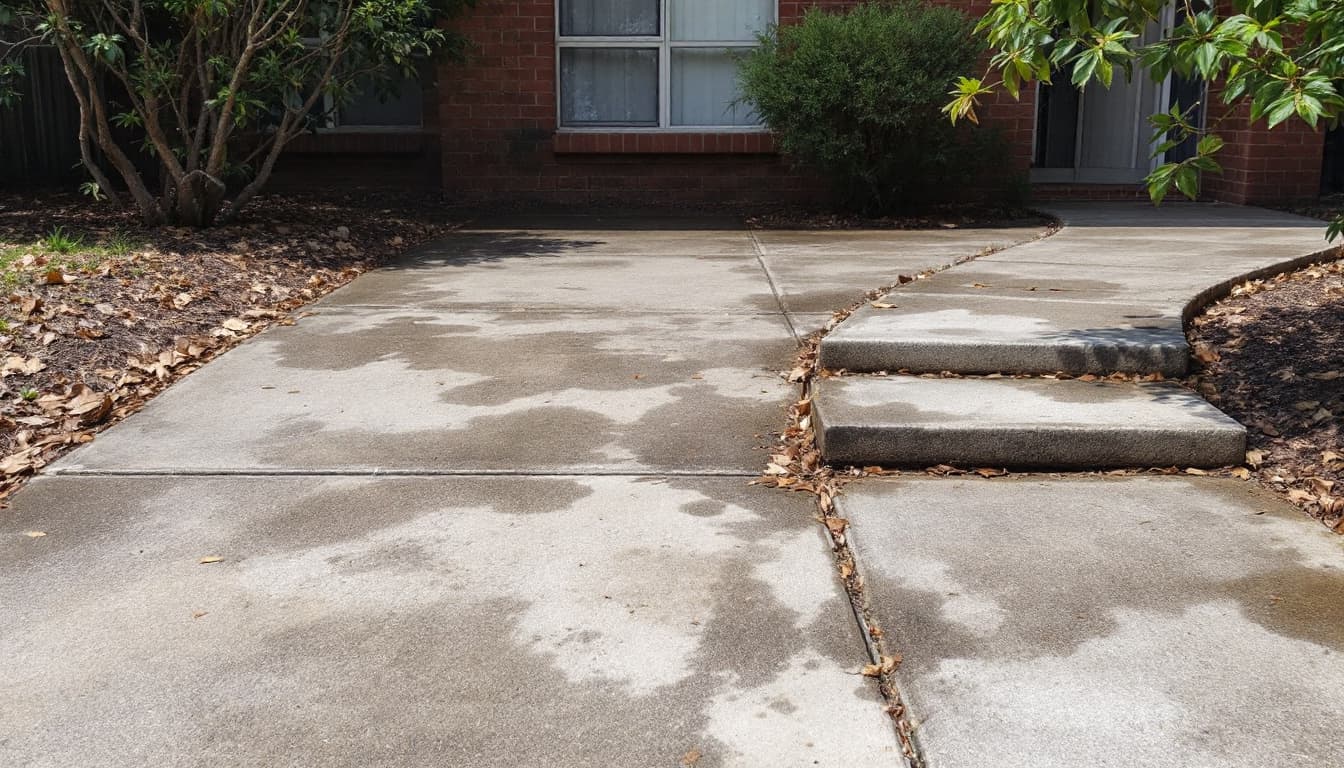
You've noticed it creeping in from the edges — that dull, greenish-grey film on the pool concourse, the black speckling along the shaded side of the driveway, the patio pavers that were honey-coloured when they were laid and are now the colour of wet cardboard. You've probably even given it a scrub with a broom and some Domestos, watched it lighten for a week, and then watched it come back darker than before. That's not dirt. That's a living colony, and a broom was never going to fix it.
Why Brisbane Concrete Goes Green Faster Than Almost Anywhere Else
What you're looking at is a mix of cyanobacteria, algae, and lichen, with black lichen and mould typically colonising the shaded, south-facing sections and green algae dominating anywhere that stays damp after rain. Brisbane's climate is close to perfect for this. We average around 1,150mm of rain a year, but the bulk of it lands in a tight window between December and March as short, intense storm bursts rather than gentle, evenly-spread falls. That pattern is the whole problem: concrete and sandstone pavers don't dry out between events, humidity sits in the high 60–80% range through summer, and overnight lows rarely drop enough to check biological growth the way a proper southern-state winter would.
Concrete and sandstone are also porous. Over time, pores fill with organic material — pollen, leaf litter, dust — and that becomes a food source and moisture reservoir sitting just below the surface. Surface cleaning with detergent kills what you can see, but the biofilm's root structure (technically a matrix of extracellular polymeric substance, essentially a protective slime layer) stays anchored in those pores. That's why it always comes back, usually within 4–8 weeks in a shaded, humid spot, and why it comes back faster each time — the biofilm regrows on itself rather than starting from scratch.
There's a second, less obvious issue: efflorescence. That white, chalky bloom you sometimes see on pavers and retaining block isn't dirt either — it's calcium carbonate leaching out through capillary action as moisture moves through the material. Standard detergents don't touch it, and scrubbing just polishes it into the surface.
The Number That Should Change How You Think About This
Untreated biological growth isn't just cosmetic. Algae and lichen retain moisture against the substrate, and in freeze-thaw climates that's a structural problem — but even here in SEQ, sustained moisture retention accelerates concrete spalling and paver joint erosion. More immediately, it's a safety and liability issue: wet algae on sealed concrete or tiled alfresco areas can reduce surface friction by a significant margin, and slip-related injury claims are one of the more common (and preventable) homeowner insurance issues in Queensland. Councils and body corporates increasingly flag algae-slick common areas and driveways during inspections for exactly this reason.
On the cost side, the maths is straightforward. A DIY consumer electric pressure washer (1,400–2,000 PSI) will shift surface dirt but typically can't generate the sustained flow rate needed to lift embedded biofilm from porous concrete — contractors doing this daily generally run petrol or commercial-grade electric units at 2,800–3,200 PSI with adjustable turbo nozzles, because that pressure-and-flow combination is what actually fractures the biofilm layer rather than just rinsing its surface. Replacing stained, spalled pavers because grime and moisture damage went unaddressed for years runs into the thousands per driveway. A professional clean, by contrast, typically sits in the low-to-mid hundreds depending on area — and extends the life of the sealed surface by protecting it before it degrades.
How to Actually Get Rid of It (Not Just Hide It)
- Assess the surface first. Sandstone, tumbled pavers, exposed aggregate, and coloured concrete all have different pressure tolerances. Sandstone above 2,000 PSI at close range will pit and strip the surface; broom-finished concrete can typically handle 3,000 PSI+.
- Pre-treat with a sodium hypochlorite or biodegradable algaecide solution, not straight detergent. This breaks down the biofilm's protective layer chemically before mechanical pressure is applied, which is what stops regrowth being immediate.
- Wash with the correct nozzle and distance — a 15–25° fan tip held at a consistent 200–300mm from the surface, working in overlapping passes with the grain of the concrete or paver joints to avoid "tiger striping."
- Flush all joints and drainage points thoroughly. Loosened biofilm and chemical residue left sitting in paver joints just reseeds the growth.
- Apply a penetrating sealer once fully dry (24–48 hours minimum in Brisbane humidity). A quality solvent-based sealer reduces porosity, which is the single biggest lever for slowing regrowth — untreated concrete will typically show new growth in 6–10 weeks; sealed concrete can push that out to 12+ months.
- Schedule a maintenance clean annually, ideally in early spring before the December–March storm season loads the surface with moisture and organic debris.
Where Yard Guru Comes In
This isn't a job where a $150 hardware-store unit and a Saturday afternoon gets you the result — wrong pressure, wrong chemical, or a rushed dry-before-sealing step and you've either damaged the surface or bought yourself six weeks before it's back. Our crews run commercial-grade equipment matched to your specific surface, use the correct pre-treatment for the growth type, and can pair the clean with a penetrating seal so you're not doing this every quarter. If your patio, driveway, or pool concourse has that tell-tale grey-green film creeping back no matter how many times you've scrubbed it, book a pressure-washing quote or see the full scope of what we cover under our services.